
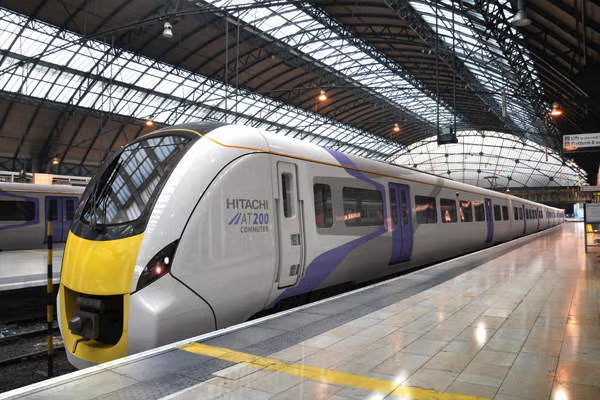
The global railway industry stands at a critical juncture where sustainability meets innovation. As nations worldwide commit to reducing carbon emissions and enhancing public transportation infrastructure, Hitachi Rail has emerged as a pioneering force in developing faster, greener energy railway solutions, including the innovative Battery Powered Train. This comprehensive analysis explores how Hitachi’s cutting-edge technologies are reshaping rail transportation across continents and driving the future of sustainable mobility.
The Evolution of Hitachi Rail Technologies
Hitachi Rail, a subsidiary of the Japanese conglomerate Hitachi Ltd., has been at the forefront of railway innovation for over a century. The company’s commitment to environmental sustainability and technological advancement has positioned it as a global leader in railway manufacturing and systems integration. Their portfolio spans high-speed trains, urban transit systems, signaling solutions, and energy-efficient rolling stock that collectively contribute to reducing the transportation sector’s carbon footprint.
The railway sector accounts for approximately 9% of global passenger transport activity and 7% of freight transport, yet it only contributes around 3% of total transport energy consumption. Hitachi recognizes this inherent efficiency advantage and has invested heavily in technologies that further enhance rail’s environmental credentials while improving speed, reliability, and passenger experience.
Battery-Powered Trains: A Game-Changing Innovation
One of Hitachi’s most significant contributions to sustainable rail transportation is the development of battery-powered trains. Traditional diesel trains emit substantial amounts of carbon dioxide and other pollutants, particularly on non-electrified rail lines. Hitachi’s battery electric multiple units (BEMU) offer a clean alternative that eliminates direct emissions while maintaining operational flexibility.
The company’s battery trains can operate on both electrified and non-electrified sections of track, charging their batteries from overhead wires where available and running on stored power elsewhere. This hybrid capability makes them ideal for routes where full electrification would be prohibitively expensive or impractical. Countries including the United Kingdom, Italy, and Japan have shown strong interest in deploying Hitachi’s battery train technology to reduce their railway networks’ environmental impact.
Field trials and operational data suggest that battery trains can reduce carbon emissions by up to 50% compared to diesel equivalents on partially electrified routes. The technology also delivers quieter operation, reduced maintenance costs due to fewer mechanical components, and improved air quality in stations and urban areas.
High-Speed Rail Systems and Energy Efficiency
Hitachi’s involvement in high-speed rail extends beyond Japan’s famous Shinkansen network. The company has supplied trains and systems for high-speed rail projects across Europe, including the United Kingdom’s Intercity Express Programme (IEP) and Italian railway operations. These high-speed trains incorporate numerous energy-saving features that demonstrate Hitachi’s commitment to sustainability.
Regenerative braking systems capture kinetic energy during deceleration and feed it back into the power grid, reducing overall energy consumption by 15-30%. Lightweight materials such as aluminum alloys and advanced composites reduce train weight, thereby decreasing energy requirements for acceleration and sustained high-speed operation. Aerodynamic designs minimize air resistance, particularly crucial at speeds exceeding 200 kilometers per hour.
The Class 800 and 801 trains operating in the United Kingdom exemplify this approach. These bi-mode trains can switch seamlessly between electric and diesel power, providing flexibility while prioritizing electric operation wherever possible. Their introduction has modernized Britain’s railway infrastructure while delivering significant reductions in fuel consumption and emissions compared to the aging rolling stock they replaced.
Digital Solutions and Predictive Maintenance
Beyond the trains themselves, Hitachi has developed sophisticated digital solutions that optimize railway operations and reduce environmental impact. The company’s Lumada platform uses artificial intelligence, Internet of Things sensors, and big data analytics to enable predictive maintenance, optimize energy consumption, and improve service reliability.
Predictive maintenance reduces unnecessary component replacements and prevents unexpected failures that can disrupt service and waste resources. By monitoring train systems in real-time and analyzing patterns, Hitachi’s technology can identify potential issues before they cause problems, extending equipment lifespan and reducing waste.
Energy management systems analyze route profiles, traffic conditions, and train performance data to recommend optimal driving strategies that minimize energy consumption. Train operators receive real-time guidance on when to accelerate, coast, or brake to achieve the most efficient journey while maintaining schedule adherence. Studies indicate that such systems can reduce energy consumption by 10-20% without compromising service quality.
Global Impact and Market Expansion
Hitachi Rail’s technologies have made significant inroads in markets worldwide, contributing to global efforts to decarbonize transportation. In Europe, the company has established a strong presence through strategic acquisitions and partnerships, becoming one of the continent’s largest railway system suppliers.
The United Kingdom represents a particularly important market where Hitachi has delivered hundreds of new trains and modernized signaling infrastructure. The environmental benefits are substantial: the replacement of older diesel trains with modern electric and bi-mode units has reduced carbon emissions from intercity rail services by an estimated 25-40%.
Italy has also embraced Hitachi’s solutions, with the company supplying trains for regional and intercity services. The focus on sustainability aligns with Italy’s commitment to the European Green Deal and its targets for reducing transportation emissions. Hitachi’s battery trains offer particular promise for Italian routes where geographic challenges make full electrification difficult.
In Asia, beyond its home market of Japan, Hitachi has secured projects in countries including Taiwan, Singapore, and India. These diverse markets present unique challenges that Hitachi addresses through customization and adaptation of its core technologies. The company’s experience across different climates, operating conditions, and regulatory environments has built robust solutions applicable worldwide.
Environmental and Economic Benefits
The environmental case for Hitachi’s railway solutions is compelling. Rail transportation already offers significant carbon advantages over road and air travel, and Hitachi’s innovations amplify these benefits. Electric trains powered by renewable energy sources can achieve near-zero direct emissions, while battery trains eliminate diesel dependency on non-electrified routes.
Noise pollution reduction represents another important environmental benefit. Electric and battery-powered trains operate much more quietly than diesel equivalents, reducing disturbance in urban areas and along railway corridors. This improvement enhances quality of life for communities near railway lines and makes rail transportation more attractive to passengers.
The economic benefits extend beyond environmental considerations. Energy-efficient trains reduce operating costs through lower fuel consumption and decreased maintenance requirements. Governments investing in railway infrastructure modernization find that Hitachi’s solutions offer favorable lifecycle costs despite potentially higher initial investment compared to conventional alternatives.
Improved reliability and service quality attract more passengers from road and air travel, generating additional revenue while further reducing overall transportation emissions. This virtuous cycle supports investment in continued railway network expansion and improvement.
Challenges and Future Developments
Despite impressive progress, challenges remain in the transition to greener railway systems. Infrastructure investment requirements are substantial, particularly for electrification projects and charging facilities for battery trains. Grid capacity and renewable energy availability must keep pace with expanding electric railway operations to ensure genuine emissions reductions.
Battery technology continues to evolve, with ongoing research focused on increasing energy density, reducing costs, and extending battery lifespan. Hitachi actively participates in this development, collaborating with battery manufacturers and research institutions to advance the state of the art.
Hydrogen fuel cell technology represents another frontier that Hitachi is exploring. Hydrogen trains offer the potential for zero-emission operation on non-electrified routes with longer range than current battery technology permits. Several European countries have expressed interest in hydrogen rail solutions, and Hitachi is developing offerings to meet this emerging demand.
Conclusion: A Sustainable Transportation Future
Hitachi’s faster, greener energy railway solutions demonstrate that environmental sustainability and technological advancement can proceed hand in hand. Through battery-powered trains, energy-efficient high-speed rail, and intelligent digital systems, the company is helping to reshape global transportation infrastructure for the 21st century.
The global impact extends beyond emissions reductions to encompass improved air quality, reduced noise pollution, enhanced passenger experiences, and economic benefits through efficient operations. As countries worldwide accelerate efforts to combat climate change and modernize infrastructure, Hitachi’s railway technologies offer proven solutions that deliver both environmental and commercial value.
The railway industry’s transformation toward sustainability is well underway, and Hitachi stands at the forefront of this change. Continued innovation, strategic investments, and collaborative partnerships will determine how quickly and comprehensively this transition occurs. The path forward requires commitment from governments, railway operators, and technology providers working together toward shared environmental goals.
For passengers, communities, and the planet, the benefits of greener railway solutions are clear and compelling. Hitachi’s contributions to this vital sector demonstrate how engineering excellence and environmental responsibility can create transportation systems that serve both present needs and future generations. The journey toward fully sustainable rail transportation continues, with Hitachi helping to lead the way.