
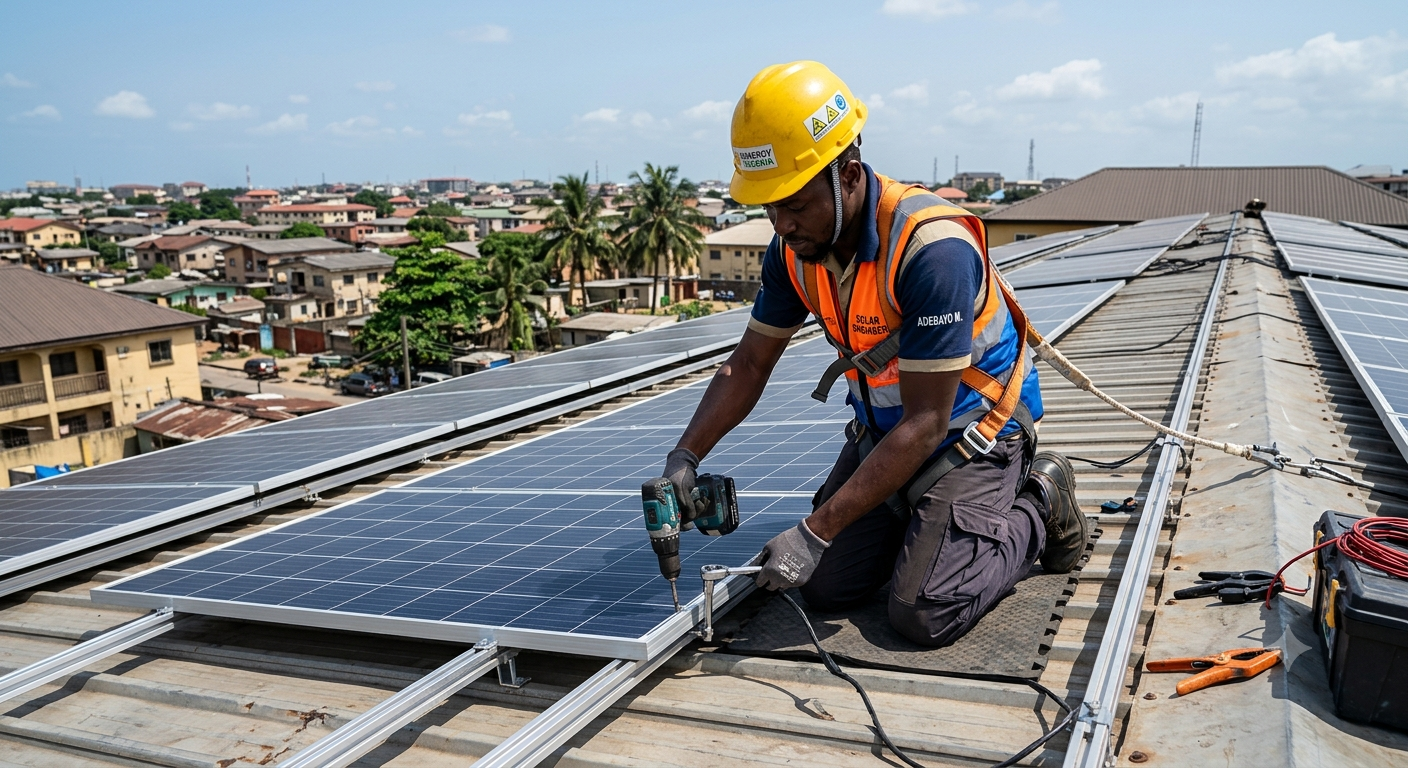
Nigeria’s rapid transition toward renewable energy has transformed the national job market. Driven by rising grid electricity tariffs, fuel price adjustments, and the decentralization of state power markets under the Electricity Act, residential estates, commercial hubs, and industrial facilities across Lagos, Abuja, Port Harcourt, and Ibadan are rapidly installing solar photovoltaic (PV) and battery storage systems. This surging demand for off-grid and hybrid power solutions has created a critical shortage of skilled technical talent. Clean-tech enterprises, Independent Power Producers (IPPs), Engineering, Procurement, and Construction (EPC) firms, and solar distributors are actively competing for qualified Solar Field Engineers and Inverter/Battery Repair Technicians. Whether you are an electrical engineering graduate, a trade-certified technician, or an experienced practitioner seeking to transition into the green economy, this comprehensive guide explores the top job roles, salary expectations, essential certifications, and career pathways available in Nigeria’s solar sector.
1. The Solar Talent Landscape in Nigeria. The Nigerian solar industry has shifted from basic home-system installations to complex, high-voltage Commercial and Industrial (C&I) microgrids, telecom power setups, and utility-scale projects. Consequently, recruiters are looking beyond basic wiring knowledge; they require specialized engineers and technicians capable of performing real-time load diagnostics, component-level repairs, and high-efficiency system commissioning.
NIGERIAN RENEWABLE ENERGY RECRUITMENT
v
SOLAR FIELD ENGINEERS | | INVERTER & REPAIR TECHS
v
System Sizing & Site Design | • Component PCB Troubleshooting
High-Voltage Grid Tie-Ins | • Inverter MOSFET & Transformer
C&I / Utility Commissioning | Lithium BMS Maintenance
Hiring activity spans multiple sectors:
C&I Solar Companies: Building multi-megawatt rooftop and ground-mounted solar plants for factories, supermarkets, and private estates.
Telecom Infrastructure Companies (TowerCos): Retrofitting telecom towers from diesel generators to solar hybrid setups across all 36 states.Inverter & Battery
Distributors: Establishing local service centers to offer warranty support and repair services for major brands (e.g., Deye, Felicity Solar, Luminous, Huawei, Must, SRNE).Pay-As-You-Go (PAYG) Solar Vendors: Expanding rural mini-grids and home systems in off-grid communities.
2. Key Job Roles & Key Responsibilities:
To position yourself effectively in the job market, it is essential to understand the distinction between field engineering roles and component repair technician positions.
A. Solar Field Engineer:
A Solar Field Engineer oversees the physical execution, testing, and system integration of solar PV infrastructure on-site. They serve as the technical bridge between engineering design teams and ground installation crews.
Key Responsibilities:
Perform pre-installation site assessments, roof load checks, and solar irradiance mapping. Review Single Line Diagrams (SLD), structural drawings, and system schematics.
Oversee stringing configuration, inverter mounting, array tilting, and balance-of-system (BOS) wiring. Conduct pre-commissioning verification: Open-Circuit Voltage ($V_{oc}$), Short-Circuit Current ($I_{sc}$), insulation resistance testing, and ground-fault diagnostics.
Ensure strict adherence to national safety codes and client engineering specifications.
B. Inverter & Solar Repair Technician:
Inverter and repair technicians specialize in bench-level diagnostics, preventative maintenance, and physical repair of power electronics, including hybrid inverters, solar charge controllers, and battery banks.
Key Responsibilities:
Perform component-level troubleshooting on printed circuit boards (PCBs).
Diagnose and replace failed power electronics components, such as MOSFETs, IGBT modules, bridge rectifiers, capacitors, and transformer logic boards.
Repair and calibrate Lithium Iron Phosphate ($\text{LiFePO}_4$) Battery Management Systems (BMS) and balance individual battery cells.
Troubleshoot operational error codes on major inverter brands (e.g., fault codes for overload, over-temperature, bus-voltage faults, or grid-synchronization failures).
Maintain precise bench service records, warranty claims, and spare parts inventory.
C. Solar Quality Assurance (QA/QC) & Commissioning Engineer
QA/QC Engineers ensure that installed solar systems meet strict technical standards before final handoff to commercial clients.
Key Responsibilities:
Conduct thermal imaging inspections using infrared cameras to detect micro-cracks and hot spots on solar PV panels.
Verify grounding, lightning protection systems (LPS), and surge protection device (SPD) ratings.
Validate grid-tie anti-islanding protection devices to ensure compliance with Nigerian Electricity Management Services Agency (NEMSA) standards.
3. Salary Structure & Compensation Packages in Nigeria.
| Title | Experience Level | Average Monthly Salary | Salary Range | Key Geographic Hubs |
| Junior Solar Technician | (0-2Years) | N150,000 | N100,000-N220,000 | Lagos,Ibadan,Kano |
| Inverter Repair Specialist (PCD) | Mid-Level (2- 5 Years) | N280,000 | N200,000-N400,000 | Lagos (Alaba/Ikeja)Abuja |
| Solar Field Engineer (C&I) | Mid-Level(3-6Years) | N450,000 | N320,000-N650,000 | Abuja, Porthacourt |
| QA/QC Commissioning Engineer Senior | (6+Years) | N850,000 | N600,000-N1,400,000 | Lagos |
| Multinational Projects Operations Management | (7+Years) | NN1,200,000 | N850,000-N2,200,000 | Lagos, Regional HQ |
Key Salary Insights:
Lagos & Abuja Premium:
Roles based in Lagos State and the Federal Capital Territory (FCT) offer 20% to 35% higher base pay compared to regional averages due to the concentration of corporate headquarters and C&I projects.
Multinational vs. Local Installers:
Foreign-backed IPPs and international clean-tech firms operating in Nigeria pay significantly higher rates, often supplementing base compensation with dollar-pegged allowances for offshore or remote field assignments.
4. Educational Qualifications & Technical Certifications:
While entry-level installer roles accept trade certificates or diplomas, advancing into lucrative field engineering and repair management roles requires formal academic training and recognized industry certifications.
ACADEMIC & PROFESSIONAL CREDENTIAL PATH
[Academic Baseline] [Professional Regulatory Body] [Specialized Technical Certification]
• B.Sc / HND Electrical • COREN Registered Engineer • NAPTIN Solar PV Certification
• B.Eng Physics/Mechatronics • NSE (Nigerian Society of Engineers) • NABCEP / NEMSA License
A. Academic Qualifications For Solar Field Engineers:
A Bachelor of Science ($\text{B.Sc}$) or Higher National Diploma ($\text{HND}$) in Electrical Engineering, Electronics Engineering, Mechanical Engineering, or Renewable Energy Systems.
For Repair Technicians:
An Ordinary National Diploma ($\text{OND}$), Vocational Trade Test Certificate (Levels 1–3), or HND in Electrical/Electronic Engineering.B. Essential Professional Certifications in Nigeria National Power Training Institute of Nigeria (NAPTIN):
Certification: NAPTIN Solar PV Installation & Design Certification (Levels 100–300).
Value: Highly requested by Nigerian government agencies, mini-grid developers, and international development partners.
Council for the Regulation of Engineering in Nigeria (COREN):
Certification: Registered Engineer or Registered Engineering Technologist.
Value: Mandatory for signing off on high-voltage commercial solar single-line diagrams, factory installations, and government tenders.
Nigerian Electricity Management Services Agency (NEMSA):
Certification:
NEMSA Electrical Installation Works License.
Value:
Legal requirement for executing grid-connected electrical wiring and safety inspections across Nigeria.
NABCEP (North American Board of Certified Energy Practitioners):
Value:
Internationally recognized. Holding a NABCEP PV Associate or Installation Professional credential makes candidates top contenders for senior positions at international solar companies operating in Africa.
5. Crucial Technical Skills & Tool Mastery:
Recruiters evaluate candidates based on hands-on practical competence. To stand out during technical interview assessments, focus on developing these core competencies:
A. Core Engineering Skills for Field Engineers:
Software Mastery:
Proficiency in PVSyst, AutoCAD Electrical, HelioScope, and HOMER Pro for system design, shade analysis, load simulation, and structural layout generation.High-Voltage & Low-Voltage
Wiring:
Expertise in cable sizing, voltage drop calculations ($\le 3\%$), AC/DC disconnect selection, circuit breaker sizing, and busbar integration.Grid-Tie Protocols: Practical understanding of grid synchronization, reverse-power relay settings, phase-matching, and zero-export control devices.
B. Core Practical Skills for Repair Technicians:
Advanced Bench Diagnostics:
Ability to operate oscilloscopes, digital multimeters, signal generators, and DC power supplies to locate shorted components on inverter motherboards.
Precision Soldering:
Mastery of surface-mount device (SMD) soldering, desoldering stations, and hot-air reworking for delicate PCB trace repairs.
Battery Management Systems (BMS) Calibration:
Experience programming BMS firmware via RS485/CAN-bus communication protocols and diagnosing cell unbalance issues in $\text{LiFePO}_4$ battery packs.
6. How to Find & Apply for Solar Jobs in Nigeria:
Navigating the clean energy job market requires targeted outreach across specialized job portals, recruitment agencies, and professional networks.
Top Hiring Companies in Nigeria:
Commercial & Industrial (C&I) Developers:
Starsight Energy, Daystar Power, Arnergy, Havenhill Synergies, CrossBoundary Energy.PAYG & Mini-Grid Operators: Jaza Energy, Lumos Nigeria, Rensource Energy, Dawnice.
Equipment Distributors & Manufacturers:
Felicity Solar Nigeria, Deye Local Service Centers, SRNE, Sako.
Job Search Strategies for Candidates:
Leverage Specialized Green Job Portals: Monitor industry portals like jobs.solarandinverterblog.com.ng for verified listings targeting field engineers, site supervisors, and bench technicians.
Build a Portfolio of Field Projects:
Create a visual portfolio (PDF or personal website links) showcasing past installations, single-line diagrams designed in AutoCAD, and bench troubleshooting case studies.
Engage Local Renewable Energy Associations:
Join professional networks such as the Renewable Energy Association of Nigeria (REAN) and the Solar Energy Society of Nigeria (SESN) to access hidden job boards and industry networking events.
7. Career Progression & Upskilling Paths:
The renewable energy sector offers rapid career growth for professionals who consistently update their skills:[Junior Field Technician] —> [Senior Solar Engineer] —> [Lead QA/QC Auditor] —> [VP of Engineering / COO]
(Years 0-2) (Years 3-5) (Years 6-8) (Years 9+)
By adding skills in emerging fields—such as Green Hydrogen systems, Utility-Scale Battery Storage (BESS), and Electric Vehicle (EV) Charging Infrastructure—field engineers and repair technicians can position themselves for lucrative long-term careers in Nigeria’s expanding clean energy market.
Salaries in Nigeria’s solar sector vary based on geographic location, technical expertise, educational background, and company scale (multinational EPC vs. local installer). Compensation typically consists of a base monthly salary plus field allowances, health insurance, performance bonuses, and hazard allowances for high-voltage site work.
Looking to learn Solar Installation as a newbie or DIY? Then click the link below