
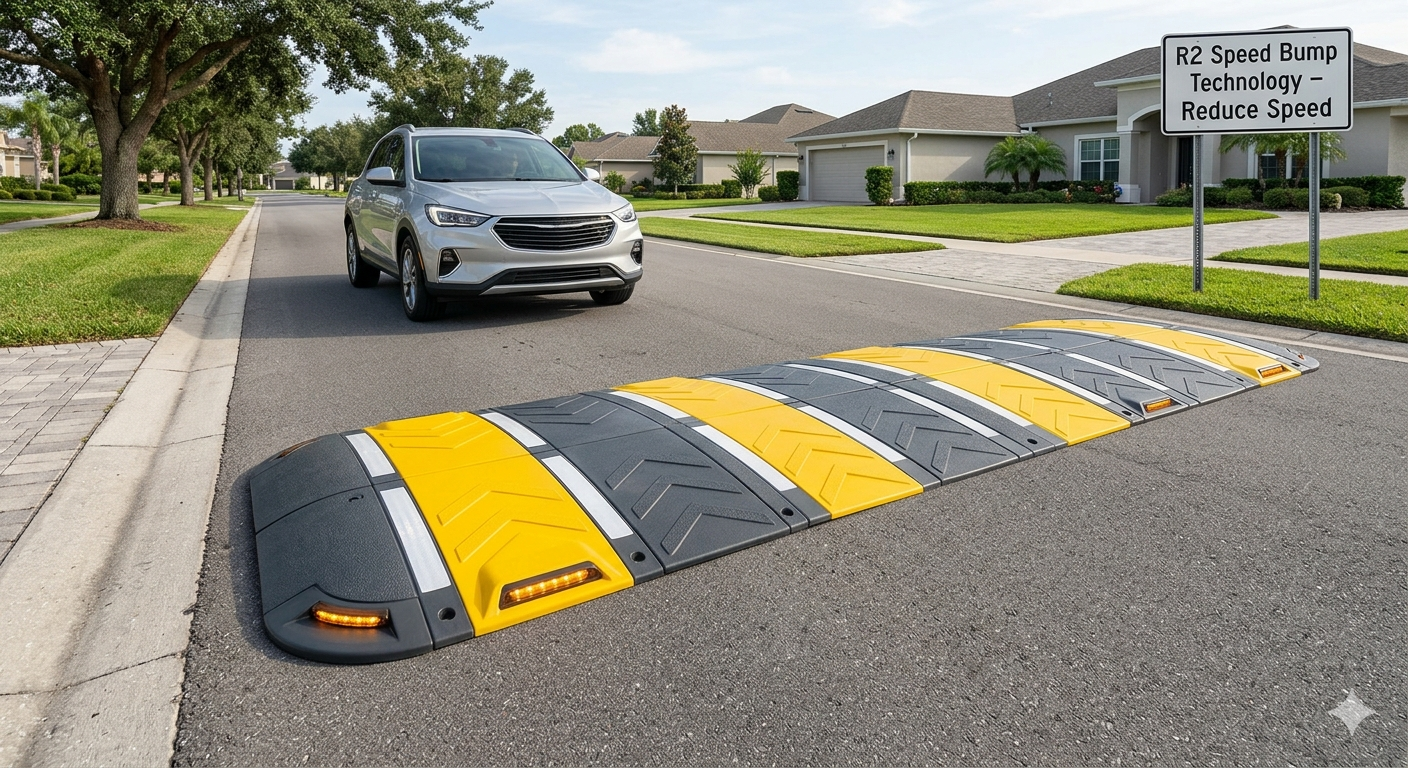
In the global quest for sustainable infrastructure, few concepts are as intuitively appealing as “harvesting” the energy we waste every day. Every time a vehicle slows down or crosses a speed bump, kinetic energy is dissipated as heat—energy that is essentially thrown away. R2 Energy Speedbump Technology (and similar road-based kinetic energy harvesting systems) represents a cutting-edge shift in civil engineering: the transformation of passive transportation infrastructure into active power-generating assets.
The evolution of road-based kinetic energy harvesters is crucial for the development of sustainable urban environments. These innovative systems not only capture energy from vehicular movement but also integrate seamlessly into existing infrastructure. The R2 Energy approach exemplifies how road-based kinetic energy harvesters can enhance renewable energy generation while promoting intelligent infrastructure solutions. By leveraging advanced materials and hybrid designs, we pave the way for a cleaner, more efficient urban energy landscape.
This technical review explores the mechanical architecture, energy output capabilities, and the critical influence of vehicle dynamics on these systems.
1. The Core Concept: What is Kinetic Energy Harvesting?
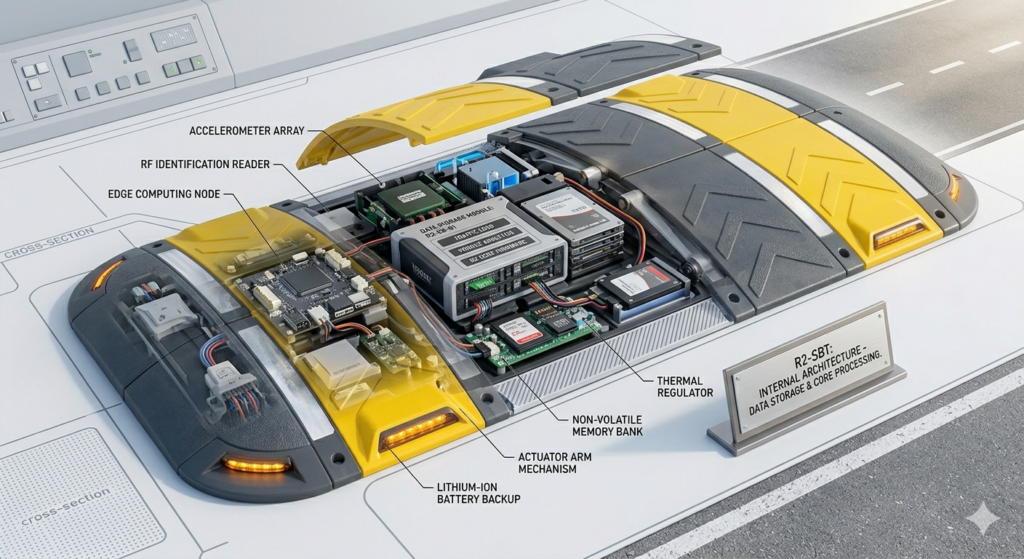
At its fundamental level, kinetic energy harvesting (KEH) in roadways utilizes the principle of energy conversion. When a vehicle drives over a conventional speed bump, the vehicle’s vertical movement is essentially a waste of mechanical energy. Kinetic roadway systems are designed to intercept this movement. By replacing passive, rubber, or asphalt humps with electromechanical devices, engineers can capture the vertical displacement of the road surface. This displacement drives an internal mechanism—often involving gears, springs, and electromagnetic induction—that generates electricity.
The Physics of the “R2” Mechanism.
Most high-performance kinetic speed bumps rely on a rack-and-pinion or crank-slider mechanism.
Vertical Displacement: As the vehicle tires depress the speed bump, the internal plate moves downward.
Mechanical Motion Rectification (MMR): This is the “secret sauce” of modern harvesters. It converts the intermittent, bidirectional vertical movement into continuous, unidirectional rotary motion. Without MMR, the system would lose significant energy during the spring-back phase.
Electromagnetic Induction: The rotating shaft spins an electromagnetic generator (dynamo), converting the mechanical torque into electrical current (AC, which is then rectified to DC).
2. Technical Specifications: Analyzing Output (kW/h)The primary question for investors and city planners is: How much power can we actually get? Experimental data and academic prototypes have shown a wide variance in power output, typically scaling with the complexity of the installation.
Power Generation Tiers: Low-Output (Piezoelectric):
Systems utilizing piezoelectric materials embedded in the pavement rely on pressure-induced charge. These are excellent for low-power sensors or traffic signals, but generally produce power in the milliwatt (mW) to low-wattage range.
Medium-Output (Mechanical/Electromagnetic):
These are the true “speed bump” harvesters. Robust mechanical systems can generate anywhere from 10 watts to 1.9 kW per activation, depending on the speed of the vehicle and the system’s gear ratio.
kW/h Calculations
To determine the daily yield, one must calculate the “Pass-by” frequency.
Example: A system rated at 0.5 kW per vehicle passage.
Traffic Volume: 200 vehicles per hour.
Total Output: Theoretically, this creates high-frequency energy bursts. However, electrical storage (battery buffering) is required to smooth out these pulses to provide a steady kW/h delivery suitable for street lighting or grid feedback.
Technical Note: The peak power output is heavily dependent on the electrical damping of the generator. Optimizing the damping constant to match the vehicle’s weight profile is essential for maximizing conversion efficiency.
3. The Impact of Vehicle Weight Classes.
A common misconception is that all vehicles produce the same amount of energy. In practice, the energy harvester must be designed to accommodate the wide spectrum of automotive weight classes.
Vehicle Class Average Mass (kg) Impact on System Energy Potential Light Passenger Cars 1,200 – 1,800 Standard Baseline SUVs / Light Trucks 2,000 – 3,000 High Significant (1.5x – 2x) Heavy Commercial Trucks 5,000+ Extreme Requires heavy-duty damp
Mechanical Load Considerations:
The system must include load-sensing mechanisms to handle heavy vehicles. If a 10-ton truck drives over a system designed for a 1-ton sedan, the mechanical components risk catastrophic failure. Consequently, high-end “R2-style” systems utilize variable resistance springs or hydraulic dampeners that adjust to the downward force, ensuring that the kinetic energy is captured efficiently regardless of the vehicle type without damaging the equipment.
4. Operational Challenges and Engineering Constraints. While the potential is massive, road-based kinetic energy harvesters face significant hurdles before they become standard urban infrastructure.
Durability and Maintenance.
Roads are harsh environments. They are exposed to extreme temperature fluctuations, water intrusion, road salt (in cold climates), and immense abrasive forces.
Mechanical Wear:
The moving parts (gears, bearings, springs) are susceptible to fatigue.
Sealing: Any ingress of moisture can corrode the internal electronics and generators, leading to short circuits.
Maintenance Cycle: Unlike a passive asphalt bump, these systems require a scheduled maintenance regime similar to elevators or industrial machinery.
Cost-Benefit Analysis:
The ROI (Return on Investment) is currently the biggest challenge. The cost of installing and maintaining a kinetic speed bump often exceeds the value of the electricity generated at current energy prices. Therefore, the value proposition should not be based solely on electricity generation, but on integrated smart city functionality:
Integrated Speed Monitoring:
Detecting vehicle speed and adjusting local traffic signals.
Safety Data Collection:
Counting vehicles and monitoring traffic patterns.
Sustainable Branding:
Utility companies and municipalities may subsidize these for their “green” PR and carbon-offset value.
5. Integrating with the Smart Grid.
The future of kinetic harvesting is not to sell power back to the main grid in massive quantities, but to provide localized power (Island Mode). By powering adjacent infrastructure—such as LED streetlights, traffic signage, smart bus stops, or even EV charging kiosks—the system avoids the inefficiencies of long-distance power transmission. In this configuration, the speed bump acts as a distributed energy resource (DER).
Energy Management Systems (EMS)
Modern implementations use a smart controller to manage the energy flow:
Rectification: Converting AC to DC.
Storage: Sending the energy to a supercapacitor or a lithium-iron-phosphate (LFP) battery bank located in a roadside cabinet.
Inversion: Converting the stored DC back into clean AC for local use.
Conclusion:
The Path Forward: Kinetic energy harvesting via speed bump technology is a highly promising field of renewable energy, yet it remains a technical challenge that balances mechanical endurance against electrical efficiency. As we look toward 2030, the focus is shifting from “just generating electricity” to “intelligent infrastructure integration.”For the technology to move from pilot projects to municipal standards, the industry must prioritize:
Standardization of mechanical components to lower manufacturing costs.
Advanced materials that offer higher strength-to-weight ratios and better wear resistance.
Hybrid designs that combine kinetic harvesting with solar or piezoelectric elements for continuous power.
The R2 Energy model of kinetic harvesting is a testament to the engineering ingenuity required to build the smart, sustainable cities of the future. By turning our roads into power plants, we take one more step away from fossil fuel dependency and toward a truly circular urban ecosystem.
The evolution of road-based kinetic energy harvesters is crucial for the development of sustainable urban environments. These innovative systems not only capture energy from vehicular movement but also integrate seamlessly into existing infrastructure. The R2 Energy approach exemplifies how road-based kinetic energy harvesters can enhance renewable energy generation while promoting intelligent infrastructure solutions. By leveraging advanced materials and hybrid designs, we pave the way for a cleaner, more efficient urban energy landscape.